
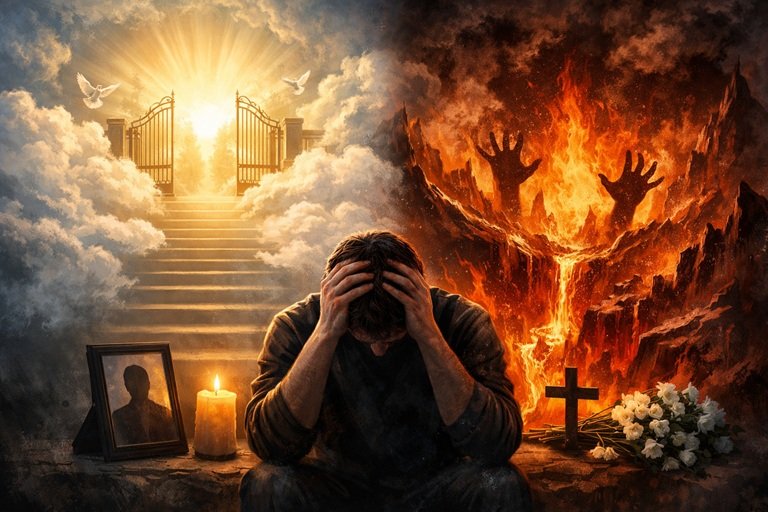
There is a question that quietly follows death in many Christian communities.
It is rarely asked loudly in public, but it is almost always whispered privately.
“Were they saved?”
“Did they accept Jesus?”
“Were they born again?”
If the answer is yes, people breathe a sigh of relief.
If the answer is no, something far darker enters the room.
Because according to a very common belief in evangelical Christianity, if the person was not “born again,” then their fate is sealed.
Not just for a time.
Not for a few years.
But forever.
Eternal torment.
Endless punishment.
Infinite suffering.
And the haunting implication is this:
If they didn’t believe the right thing before they died, then they are now in hell.
The Quiet Horror of This Belief
In the Bible Belt where I live, this belief is extremely common.
Many Christians will never say it directly at a funeral. But the thought is there, hanging quietly in the background.
Was he saved?
Did she accept Jesus?
Did they say the prayer?
If the answer is uncertain, people often feel a strange mixture of grief and fear. Not just grief over the person’s death, but fear about where that person might be now.
Think about how psychologically disturbing this is.
Imagine losing someone you love — a friend, a parent, a sibling, or a child.
And instead of simply grieving and remembering their life, you are forced to ask yourself:
What if they are burning in hell right now?
This is not a minor theological idea.
This is a belief system that follows people into their deepest moments of grief.
And it turns love into anxiety.
The Fear That Follows People Their Whole Lives
For many people, this fear never goes away.
It lingers in the background of relationships.
People worry about their children.
They worry about their friends.
They worry about their parents.
And sometimes they even worry about strangers.
Because if eternal hell is real, then the stakes are unimaginably high.
This creates a constant psychological pressure:
What if the people I love die without being saved?
This fear is often presented as compassion.
But in reality, it is a burden that no human being should have to carry.

My Own Personal Experience With This Fear
I am no longer afraid of dying and going to hell.
But I do worry about something else.
I worry about the people I love worrying about me.
Because I know that some of them still believe that unless a person accepts Jesus in a very specific evangelical way, that person will suffer in hell forever.
And because I no longer believe the way I once did, there is a real possibility that some of my loved ones might think that about me someday.
Think about how tragic that is.
If I die, I don’t want the people who love me to imagine me suffering forever.
I don’t want them lying awake at night wondering if I am burning in hell.
And honestly, if I were on my deathbed and knew that saying a certain prayer would give them peace of mind, I might even say it.
Not because I believed it was necessary.
But because I would want to comfort them.
That alone reveals how strange this belief really is.
The Logical Problem
The theology itself collapses under even basic moral reasoning.
According to the traditional evangelical view, salvation depends primarily on belief.
Not character.
Not kindness.
Not compassion.
Not the life a person lived.
Instead, everything hinges on whether a person accepted a particular belief about Jesus.
This leads to some truly disturbing implications.
Imagine two people.
The first person spends their life being kind, generous, compassionate, and loving to others. They help the poor, care for their family, and try to make the world a better place.
But they never accept evangelical Christianity.
According to this theology, that person will suffer in hell forever.
Now imagine another person.
This person lives a terrible life. They harm others, exploit people, and commit terrible crimes.
But right before dying, they say a “sinner’s prayer” and accept Jesus.
According to this same theology, that person goes to heaven.
Think about what that means.
A loving person burns forever.
A monster receives eternal paradise.
All because of a belief.
If this were proposed in any other context, most people would recognize it immediately as morally absurd.
The Global Problem
There is another issue that is even more devastating.
The vast majority of people who have ever lived on Earth have never even heard of Jesus Christ.
Entire civilizations lived and died before Christianity existed.
Millions of people today grow up in cultures where Christianity is not the dominant religion.
Are we really supposed to believe that the Creator of the universe designed a system where eternal salvation depends on hearing about a man born in first-century Judea?
A system where geography determines eternity?
A system where the wrong birthplace means eternal torment?
If a loving God exists, this simply makes no sense.

A Simpler and More Beautiful Possibility
There is a far more reasonable way to understand the divine.
If there truly is a source behind the universe — a reality of love, consciousness, and goodness — then that reality is surely greater than human religious systems.
It would not depend on a particular prayer.
It would not depend on belonging to the correct denomination.
And it certainly would not condemn billions of people simply for being born in the wrong culture.
A God worthy of the name would recognize goodness wherever it appears.
Love would matter.
Compassion would matter.
The heart of a person would matter.
Not the exact words of a belief statement.
Let Grief Be Grief
When someone dies, we should not be forced to run their life through a theological checklist.
We should not be wondering whether they said the right prayer.
We should not be imagining eternal torture.
We should be remembering who they were.
We should be honoring the love they gave.
We should be grieving, healing, and celebrating their life.
That is what love does.
Love remembers.
Love honors.
Love lets people rest.
The Good News That Religion Forgot
The universe is far bigger than our religious categories.
Whatever the ultimate truth about life and death may be, it is almost certainly not the small and cruel system that many people were taught.
A God who created galaxies is not limited by our denominations.
A God who created humanity surely understands humanity.
And if the source of reality is truly love — as many spiritual traditions suggest — then love will have the final word.
Not fear.
Not dogma.
Not a prayer formula.
Love.