
A Progressive Christian Belief Statement: A Healthier Alternative to Fundamentalism
The Simple Revelation is not a progressive Christian movement. It is not another denomination, another interpretation of the Bible, or another attempt to repair Christianity. It is something simpler and more universal than that. Still, progressive Christianity played an important part in my journey, and I remain grateful for what it gave me when I needed it.
There was a time when I could no longer accept the fundamentalist Christianity I had been taught, but I was not yet ready to walk away from Christianity altogether. I needed room to question. I needed a version of faith that did not require me to silence my reason, condemn innocent people, or live in constant fear of getting something wrong. Progressive Christianity gave me that room.
It became a bridge between the faith I had inherited and the Simple Revelation I would eventually embrace. And I believe it could become that kind of bridge for other people too.
Not everyone is ready to leave Christianity. Some people may never want to leave it—and they may not need to. If Christianity continues to give someone hope, meaning, community, or a connection with God, I would much rather see that person embrace a healthier form of Christianity than remain trapped in toxic dogma, shame, judgment, and fear.
The following belief statement reflects what I believed while I was a progressive Christian. I do not hold every idea in exactly the same way today, but I still believe there is something valuable here. These beliefs helped me heal. They helped me make sense of God, the Bible, suffering, sin, and the human condition in a healthier way. And perhaps they can help someone else do the same.
God Is Bigger Than Religion
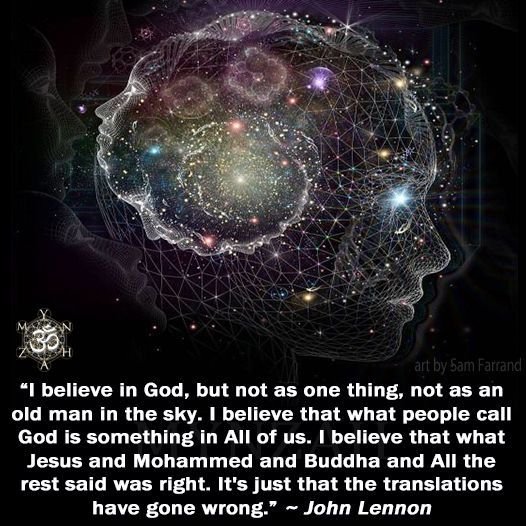
I do not believe in God as an old man sitting somewhere above the clouds, watching everything we do and waiting for us to make a mistake. That image of God may be familiar, but I no longer find it believable—or helpful.
I believe in a higher power, a divine reality, or a source consciousness that is far greater than any one religion, holy book, or human mind could ever fully contain. We may use words such as God, Spirit, Source, or Divine Love, but every word we choose will fall short. If God is truly infinite, then God must be bigger than all our definitions.
There is a great deal about God that I do not claim to understand. But there is one thing I believe we can understand: love.
However we define God—he, she, it, they, or something beyond all those categories—I believe God is ultimately love. Not merely loving, as though love were one of many qualities God possesses, but love at the deepest level of being.
That belief became the foundation beneath everything else.
A Healthier Form of Christianity
I reject fundamentalism and many of the beliefs and practices that have become common within the Christian church. I cannot accept a faith that demands unquestioning obedience, treats doubt as rebellion, condemns people for being different, or asks us to defend cruelty simply because it appears in a religious text.
But many of us were raised in Christendom. Christianity shaped our language, our imagination, our families, and the way we learned to relate to God. Walking away from fundamentalism does not automatically erase that history.
That is why progressive Christianity became meaningful to me. It offered a form of Christianity that was more open, inclusive, tolerant, egalitarian, rational, and compassionate. It allowed me to keep what was beautiful in my faith while questioning what was harmful.
It gave me a healthier way to relate to God, to other people, and even to myself.
Jesus and the Cosmic Christ
I have had doubts about the historical Jesus and about how much we can know with certainty regarding his life. But I have still found deep meaning in the Christ described in the New Testament, especially in the Gospel of John.
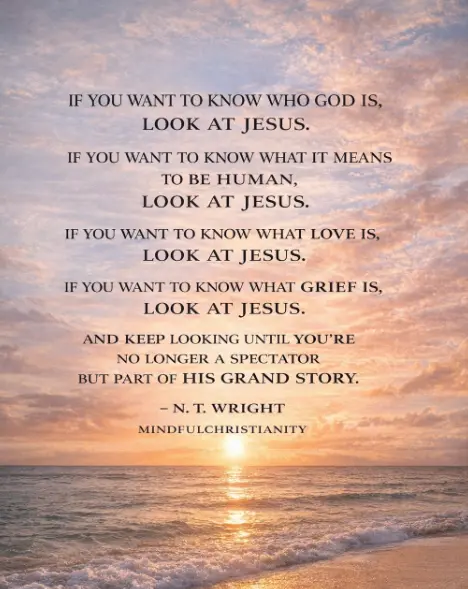
The Jesus we encounter in those writings is a beautiful representation of what God may be like—and of what human beings can become when we live according to our higher nature.
Jesus shows compassion to the rejected. He challenges religious hypocrisy. He places mercy above legalism. He touches people others consider unclean, eats with people society despises, and repeatedly brings the conversation back to love.
That is what I mean by the Cosmic Christ. Christ is not merely a religious label attached to one person in ancient history. Christ represents the divine nature within humanity—the part of us that is capable of compassion, courage, forgiveness, truth, and self-giving love.
When we live according to that higher nature, we reveal something of God.
And once again, it all comes back to love.
How I Learned to Read the Bible Differently
I once believed that calling the Bible “inspired” meant I also had to believe it was infallible and inerrant. I thought every passage had to be historically accurate, morally perfect, and directly dictated by God. If one part failed, it seemed as though the entire structure of my faith would collapse.
Progressive Christianity gave me permission to see the Bible differently.
I could believe that the Bible was inspired without pretending it was perfect. I could recognize it as a library of writings created by many flawed human beings across many centuries. Those writers lived in cultures very different from ours. They had limited knowledge of science, psychology, medicine, history, and the universe. Their writings reflect both genuine spiritual insight and ordinary human limitation.
First, I learned to treat the Bible as the historical library that it is. Then I could search for the spiritual meanings that help us relate to God, ourselves, other people, and the world around us.
My guiding hermeneutic became love and reason.
If a literal interpretation produced cruelty, fear, exclusion, or nonsense, I no longer felt obligated to defend it. I could question it. I could interpret it symbolically. I could place it in its historical setting. And sometimes I could simply reject it.
Some Christians call this cherry-picking. But everyone interprets the Bible selectively, including the people who claim they do not. The question is not whether we choose between passages and interpretations. The question is what standard guides those choices.
My standard became love and reason.
I was not trying to throw the baby out with the bathwater. I was learning that the Bible could contain flaws and still offer spiritual wisdom. It did not have to be perfect to be valuable.
The Gospel as Truly Good News
The gospel should be good news. Yet the version many of us were taught sounded more like a threat: believe the correct doctrines, say the right prayer, and remain on God’s good side—or face eternal punishment.
That never sounded like good news to me.
I came to understand the gospel differently. The good news is that God is like Jesus. God is love. God is not hurling thunderbolts or waiting for us to mess up so he can punish us. God is not keeping a heavenly list of every failure and holding it over our heads.
God is love.
God-love is patient. God-love is kind. God-love does not envy or boast. God-love is not proud, rude, self-seeking, or easily angered. God-love keeps no record of wrongs. God-love does not delight in evil but rejoices in truth. God-love protects, trusts, hopes, and perseveres.
God-love never fails.
The gospel is also the good news that Christ represents our truest nature. Everyone is in God, and God is in everyone. Nothing can separate any of us from divine love.
No one is beyond redemption. Justice is restorative rather than merely punitive. There is no ultimate us against them. We are all loved, and at our deepest level, we are all expressions of love learning how to live as love in this world.
That is a gospel worthy of being called good news.
What Are We Here to Do?
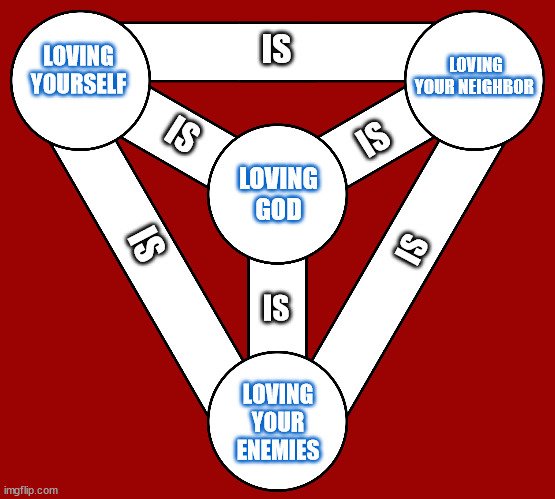
Our purpose is not complicated. We are here to be loved by God, to love God, to love other people, and to learn how to love ourselves.
We should help people develop their own relationship with God—not control that relationship for them. We should help them see God, know God, and experience divine love for themselves. No religious leader should stand between another person and God as though they possess special access that everyone else lacks.
It is our calling to see Christ in everyone. That does not mean pretending everyone behaves well. People can be selfish, destructive, cruel, and deeply wounded. But beneath those behaviors is still a human being capable of moving toward something better.
Our task is to encourage that better, Christlike nature rather than feeding the carnal, beastlike side of ourselves.
And our calling is practical. We are here to love our neighbors and ease the suffering of the human condition. Sometimes that means something as small as offering a smile that brightens someone’s day. Sometimes it means building a hospital, fighting injustice, feeding the hungry, caring for the sick, or changing a system that harms people.
Good can sometimes grow out of suffering, but that does not mean suffering itself is good. Jesus consistently treated suffering as an adversary. He healed people, fed people, comforted people, and restored those who had been cast aside.
The more we alleviate suffering, the more we bring God’s kingdom to earth as it is in heaven.
That, to me, was the real goal of progressive Christianity. It was not merely about getting into heaven after death. It was about making our earthly home more like heaven in the here and now.
The Problem of Evil
The problem of evil has always been one of the hardest questions for anyone who believes in a loving God.
I reject the idea that God created evil. I also reject the idea that every tragedy is part of God’s plan. When someone is abused, when a child becomes sick, when war destroys innocent lives, or when a natural disaster wipes out a community, I cannot look at that suffering and call it God’s will.
Trying to reconcile evil with a personal God may be nearly impossible. I do not pretend to have a perfect explanation, but several ideas helped me think about the problem in a healthier way.
First, there may be no logical reason for evil because evil itself is illogical. Trying to construct a satisfying reason for something fundamentally senseless may be an impossible task. The Gospel of John calls Christ the Logos—the divine reason or ordering principle. Perhaps every time we apply compassion, reason, and wisdom to the world’s problems, we participate in Christ and bring more of God’s kingdom into the world.
Second, I began to question the traditional claim that God must be all-powerful and all-knowing in the way Christians usually define those words. What if the most important thing about God is not unlimited power, but unlimited love?
Love does not control. Love does not force itself upon another person. Love allows freedom, and genuine freedom makes our choices unpredictable. As Jim Burklo wrote, if God is love, then God may be omnipresent without being omnipotent or omniscient in the traditional sense. We can follow the light of divine love and do what is right, or we can ignore it and do harm.
This does not explain natural evils such as earthquakes, but it offers a way to understand human-caused evil without blaming God for every terrible decision people make.
Third, suffering is not proof that God has abandoned us. The image of Christ on the cross shows God present within human suffering—not standing at a safe distance from it. God knows our pain. God has compassion for us. God suffers with us and helps us endure until healing or a solution becomes possible.
Finally, we face a choice in how we respond. We can blame God, become bitter, and reject every source of help. Or we can stop assuming that suffering must have been God’s will and begin looking for the love, courage, wisdom, and community that will help us overcome it—or at least endure it.
None of these ideas makes suffering easy. But they freed me from the crushing belief that every tragedy had been deliberately sent by God for some mysterious reason.
Rethinking Morality and Sin
Christianity taught many of us to treat sin as a long and complicated list of forbidden behaviors. We learned to examine ourselves constantly, searching for impure thoughts, wrong desires, forbidden pleasures, or small technical violations that might offend God.
But I came to believe that many things Christians call sins are not morally wrong at all.
Jesus redefined the heart of morality through the New Covenant. The New Testament reduces the law to two central commands: believe in Christ and love one another. For the purpose of morality, the second command gives us the clearest guide.
Paul wrote that love fulfills the law because a person who loves their neighbor will not intentionally harm them. If I genuinely love someone, I will not murder them, steal from them, cheat them, rape them, exploit them, or maliciously tear them down.
Jesus’ command to love our neighbors is essentially the Golden Rule: treat other people the way you would want to be treated.
Living righteously does not have to be more complicated than that.
Of course, all of us fall short. We get tired, angry, impatient, and selfish. We say ugly things. We hurt people. The point is not to become obsessed with moral perfection. The point is to try not to be an asshole.
And when we do hurt someone, we should not hide behind the idea that God has already forgiven us. We should apologize to the person, take responsibility, and do what we can to make things right.
Thoughts Are Not Actions
Having an unwanted or disturbing thought is not the same as committing an evil act. Thoughts are just thoughts. Random, silly, sexual, and even frightening thoughts can rise from the subconscious without our permission.
We do not have to condemn ourselves for every thought that passes through our minds. What matters is what we choose to nurture and what we choose to do. If we do not dwell on harmful thoughts, allow them to take root in our hearts, and turn them into harmful behavior, we do not need to live in endless mental battles.
Attraction Is Not Dehumanization
Many Christians—especially men—have tormented themselves over Jesus’ words about looking at someone with lust. Some have interpreted the passage to mean that noticing sexual beauty is nearly equivalent to committing a sexual offense.
But Jesus was confronting hypocrisy. He was speaking to religious men who publicly condemned sexual sinners while privately nurturing the same desires in their own hearts. His focus was not the involuntary experience of attraction. His focus was what was happening within the heart.
Finding someone sexy is a natural biological response. Enjoying beauty is not automatically sinful. The moral issue is whether we stop seeing the person as a human being.
We should never reduce someone to a sexual object. The person we find attractive is still a complete human being with dignity, value, dreams, fears, and a fragile heart like the rest of us. Attraction becomes healthier when it remains connected to respect.
There is nothing wrong with appreciating beauty where we find it—as long as we remember the humanity of the person we are looking at.
Consensual Sex
Sex is a natural part of human life, just like eating, breathing, and sleeping. Consensual sex outside a monogamous marriage is not automatically immoral simply because a religious tradition says it is.
The real moral questions involve consent, honesty, responsibility, health, and harm. Rape and molestation are clearly wrong because they violate and injure another person. Sexual addiction can also become destructive when it prevents someone from living a healthy and balanced life.
But sex itself is not dirty, shameful, or evil.
Other Things That Are Not Automatically Sinful
Divorce is not always wrong. Sometimes ending a marriage is necessary for the health and safety of the people involved.
Cussing is not automatically sinful. The moral question is whether we are using our words to harm someone.
Drinking, smoking, or using drugs is not automatically a moral failure, although these things can become harmful and should be approached responsibly.
Piercings, tattoos, jewelry, secular music, and other so-called “worldly” pleasures are not inherently wrong either.
The heart of the matter is harm. Are we hurting another person? Are we destroying ourselves? Are we violating someone’s dignity, freedom, or wellbeing?
If something passes that test, there is no reason to turn morality into a complicated legal code. We do not need to scrutinize every detail of our lives like religious lawyers. Most of us understand what it means to treat people decently.
Nobody is perfect. Everyone is going through something. So try to be kind. Try to be patient. Do not do anything reckless or cruel. Try to live a healthy, balanced life.
And again, try not to be an asshole.

What May Happen After Death
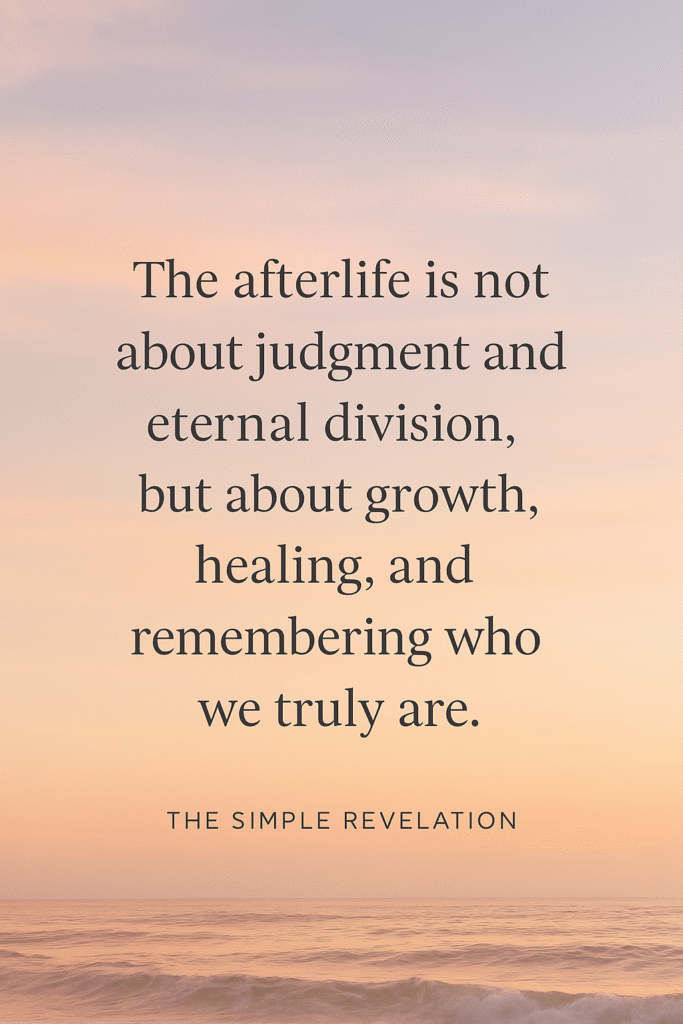
I vehemently reject the doctrine of eternal conscious torment. The idea that anyone could suffer for trillions upon trillions of years without end is not justice. It serves no restorative purpose. It is one of the most horrifying ideas human beings have ever attached to God.
At the same time, I have to admit that even the idea of remaining in heaven forever can sound exhausting. Perhaps that is why some spiritual traditions imagine that we chose to come to earth in the first place.
The truth is that no one knows with certainty what happens after we die.
I would like to believe that everyone eventually has an encounter with God similar to the one portrayed in The Shack. We meet divine love, face the wounds and traumas that shaped us, and work through the pain we caused and endured. Then, when healing has taken place, we are ready to enter paradise.
Another book that influenced me was God Took My Clothes. Its author summarized accounts from more than six hundred people of different faiths who reported near-death experiences. According to those accounts, most people—including gay people, atheists, and followers of non-Christian religions—described peaceful experiences that inspired them to become more loving when they returned.
The more frightening experiences tended to come from people who had lived destructively or under intense religious guilt and condemnation. But even those hellish experiences did not last forever. Eventually, those people were rescued too.
One especially interesting idea is the life review, in which people feel what they caused others to feel—the joy as well as the pain. That possibility makes more moral sense to me than divine revenge. It would allow us to understand the true effects of our lives, learn from them, and heal.
Of course, I cannot prove that near-death experiences reveal an actual spiritual realm. They may be genuine glimpses beyond death, or they may be dreams and hallucinations produced by a dying brain flooded with chemicals. I remain open to both possibilities.
I also find meaning in the image of a wave returning to the ocean. For a brief time, the wave appears to be separate. It rises, takes shape, moves through the world, and then settles back into the water from which it came.
Perhaps we are the waves, and God—or the universe—is the ocean. We appear for a little while, and then we return to the greater reality that has held us all along.
Satan, Demons, and the Evil Within Us
I do not believe in a literal fallen angel named Satan or in literal demons roaming the world.
If such beings existed, I could never understand why a loving and powerful God would allow them to terrorize humanity. The New Testament itself says that God is capable of restraining rebellious spiritual beings. Why, then, would God allow a supernatural psychopath to wander freely, deceiving and tormenting people?
It makes no sense to me.
Ancient people did not understand the brain, mental illness, neurological disorders, or many physical diseases the way we do today. Conditions they attributed to demons can now often be traced to malfunctions in the body and brain. Belief in demonic possession can make those conditions worse by surrounding vulnerable people with shame, terror, and superstition instead of giving them appropriate care.
The word satan itself simply means adversary. In the Bible, an adversary can be called a satan, and God is even described as acting as an adversary to Israel in 2 Chronicles.
That does not mean the images of Satan and demons have no value. They can still be powerful metaphors.
We speak of “battling our demons” when we struggle with addiction, depression, anger, shame, fear, destructive habits, or negative thoughts. Satan can represent the inclination within human beings to choose selfishness and cruelty over love.
Understood in that way, the gospel still contains a meaningful victory over Satan.
The inclination toward evil is defeated by the cross—not as a magical transaction, but as a symbol of self-sacrificial love. We overcome the beastlike part of ourselves by awakening to our identity in Christ. With God’s help, we can face our struggles and loosen the grip of shame, fear, guilt, and hatred.
The voices in our minds that tell us we are worthless, unforgivable, or permanently broken do not have to torment us forever.
We can find peace.
We can heal.
And we can live knowing that we are always, completely, and inexhaustibly loved.
Rethinking the End Times
One of the most harmful teachings I encountered in evangelical Christianity was the modern futurist view of the end times—especially the pre-Tribulation rapture theology popularized by books and movies such as Left Behind.
According to this view, the world must become increasingly evil before Jesus returns. Christians will suddenly disappear, the Antichrist will take control, and everyone left behind will endure years of war, disaster, and unimaginable suffering.
I now believe this theology is toxic.
It can cause Christians to view tragedy with a strange sense of excitement. Wars, diseases, natural disasters, and political unrest become signs that prophecy is unfolding. Working for peace can even seem pointless because everything supposedly has to get worse before Jesus returns.
This theology teaches escape instead of restoration. The goal becomes leaving the earth before it falls apart rather than helping to heal the world Jesus told us to love and serve.
Preterism and Better Covenant theology offered me a much healthier understanding. Instead of assuming that Jesus and the apostles were describing events thousands of years in their future, preterism takes their time-sensitive language seriously.
Jesus said that some standing with him would still be alive when these events occurred. He said that “this generation” would not pass away until everything he described had taken place. The apostles told their own audiences that the time was near, the end was approaching, and the Judge was standing at the door.
Those statements make far more sense if the end-times passages concerned the people who originally heard them—not people living two thousand years later.
From this perspective, the “end of the age” was not the end of planet Earth. It was the end of the Old Covenant age centered around the Jerusalem Temple, its priesthood, and its sacrificial system. That age came to a devastating conclusion when the Romans destroyed Jerusalem and the Temple in A.D. 70.
This does not mean that God directly caused the terrible things the Romans did. Rome was responsible for Rome’s cruelty. The violence, starvation, and destruction resulted from human choices, imperial brutality, and war—not from a loving God personally tormenting people.
It is also important not to blame Jewish people collectively. Jesus, his apostles, and the earliest Christians were Jewish. Many Jewish people accepted his message. But certain leaders and revolutionary factions rejected Jesus’ way of peace and chose armed resistance against Rome. Jesus warned where that path would lead. Violence produced more violence, and Rome responded with overwhelming brutality.
God did not need to cause that suffering. Human beings and empires experienced the consequences of the violent path they had chosen.
Better Covenant theology also helped me see that the end of the Old Covenant was not merely about destruction. It marked the beginning of something new. God’s kingdom would no longer be centered around one physical Temple, priesthood, or nation. It would spread through people practicing love, mercy, justice, reconciliation, and service.
That gives Christians a much healthier mission.
We do not have to believe that the world must go to hell in a handbasket before Jesus can return. We do not have to wait for the Antichrist to destroy half the world or treat every war and disaster as another clue in an end-times puzzle.
Our responsibility is to advance the kingdom Jesus described. We do that whenever we feed the hungry, care for the sick, welcome the rejected, pursue peace, oppose injustice, forgive our enemies, and relieve suffering.
In that sense, Christ returns and his kingdom comes through people embodying the love of Christ in the world. Jesus taught us to pray for God’s kingdom to come and God’s will to be done “on earth as it is in heaven.” The goal is not to abandon the earth because we expect it to become hopeless. The goal is to help make the earth more like heaven.
That is a far healthier vision of the future. It replaces fear with hope, escape with responsibility, and destruction with restoration.
A Bridge Worth Keeping
I no longer identify as a progressive Christian, and the Simple Revelation is not another form of Christianity. It does not depend on the Bible, a church, a creed, or any one religious figure. Its central truth is simpler: love is the highest truth, and we should build our lives around reducing suffering, treating people with compassion, and recognizing our shared humanity.
Still, I remain grateful for progressive Christianity and the role it played in my journey.
It gave me room to question beliefs that were hurting me without feeling that I had to abandon everything at once. It allowed me to rethink God, Jesus, the Bible, hell, sin, morality, and the afterlife through the lens of love rather than fear.
For a time, that was exactly what I needed.
And I believe many other people may need the same kind of bridge. Not everyone is ready to leave Christianity. Not everyone wants to. If the Christian story continues to give someone hope, meaning, community, or a connection with God, I would rather see that person embrace a loving, inclusive, rational, and healthy version of it than remain trapped in condemnation and toxic dogma.
You do not have to agree with every statement in this manifesto. I do not hold every idea exactly as I did when I first wrote it. The details matter, but the direction matters even more.
Away from fear and toward love.
Away from condemnation and toward restoration.
Away from division and toward our shared humanity.
A person can move in that direction as a progressive Christian, through another spiritual tradition, or without religion at all.
Wherever we begin, the Simple Revelation remains the same: we are all human, we are all connected, and love is the way forward.