
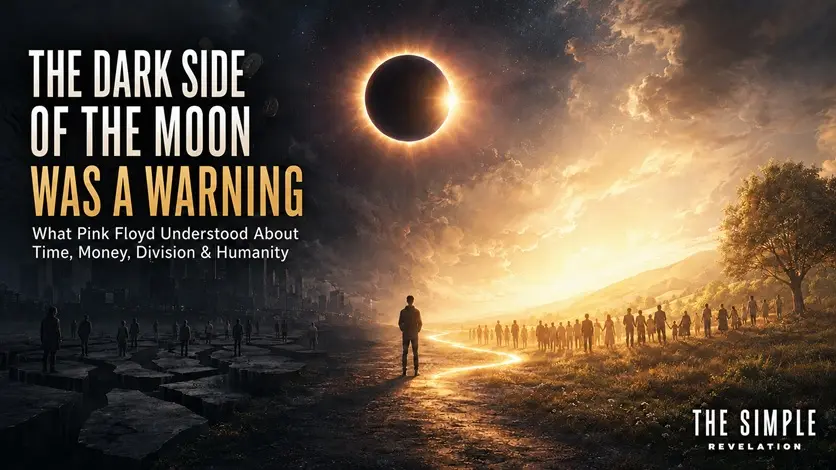
Pink Floyd’s The Dark Side of the Moon: A Warning About Losing Our Humanity
Pink Floyd’s The Dark Side of the Moon has always been one of my favorite albums. I especially appreciate “Time” and “Money” because they are more than great songs. They are philosophical reflections on two forces that control much of human life.
“Time” confronts us with how quickly our lives pass. “Money” exposes the emptiness of greed and materialism. Then comes “Us and Them,” a song about the divisions we create between ourselves.
As I began looking at these songs as parts of one larger message, I started to wonder if the album was telling a spiritual story. Perhaps the “lunatic” mentioned near the end represents someone who has become spiritually blind. This person has been consumed by money, social expectations, conflict, and the pressures of modern life until he can no longer recognize his own humanity.
That interpretation is not far from what Pink Floyd intended. The Dark Side of the Moon is an exploration of the forces that can gradually cause human beings to lose their sanity, freedom, compassion, and sense of meaning.
The Things That Make People Mad
Roger Waters originally proposed that Pink Floyd create an album about “the things that make people mad.” The band explored the pressures that weigh upon nearly everyone: work, anxiety, time, death, money, greed, war, social division, and the feeling that we are losing control of our own lives.
The album begins and ends with a heartbeat. Between those heartbeats, it takes us through something resembling an entire human life.
We are born. We breathe. We run. We work. We watch the years pass. We face death. We pursue money. We divide ourselves into competing groups. We struggle with our minds. Finally, everything is brought together in “Eclipse.”
This makes The Dark Side of the Moon more than a collection of songs. It is a meditation on what it means to be human in a world that constantly threatens to make us forget.
“Time”: Waiting for Life to Begin
“Time” is one of the most painfully honest songs ever written about growing older.
When we are young, time seems almost endless. We spend our days waiting for something to happen. We assume that our real life will begin later, perhaps when we finish school, find the right job, have enough money, meet the right person, or finally become the person we intended to be.
Then one day, we realize that life was happening the entire time.
The tragedy in “Time” is not simply that we die. It is that we may reach the end of life without ever having fully lived. We can spend decades following routines, meeting expectations, and preparing for a future that never quite arrives.
The song asks us to wake up before it is too late.
This connects with “Breathe,” which offers a quieter alternative. We can care about people. We can choose our own path. We can stop allowing work, fear, and social expectations to consume our entire existence.
Time itself is not the enemy. The enemy is living unconsciously while time slips away.
“The Great Gig in the Sky”: Confronting Death
“The Great Gig in the Sky” follows “Time,” and that placement is important. After confronting the passage of life, we must confront where time ultimately leads.
The song represents death and the emotional experience of facing it. A voice calmly explains that there is no reason to fear dying because death comes to everyone. Then Clare Torry’s wordless vocals carry us through a storm of emotion.
Her voice seems to move through fear, resistance, pain, grief, surrender, and finally peace. No words are necessary because death reaches deeper than language.
The song is spiritual without promoting a particular religion. It does not tell us exactly what happens after death. It simply creates the overwhelming feeling of standing at the edge of something greater than ourselves.
In the context of the album, death also gives urgency to everything that came before it. If our time is limited, then how should we live? What deserves our attention? What are we chasing, and why?
Then, immediately after this profound encounter with mortality, we hear the sounds of cash registers and coins.
“Money”: The Great Distraction
“Money” is a sarcastic criticism of greed, consumerism, and the belief that wealth will give our lives meaning.
Money is necessary in society, but it easily becomes something more than a practical tool. It becomes a measure of human value. We judge success by what people own, where they live, what they wear, and how much influence they possess.
This can cause us to spend our brief lives accumulating things while neglecting our relationships, our inner growth, and the needs of others.
The placement of “Money” directly after “The Great Gig in the Sky” creates a powerful contrast. We confront the mystery of death, and then we immediately return to counting our money.
It is almost as if society uses materialism to distract us from the deepest questions of existence.
Rather than asking who we are, why we are here, and how we should treat one another, we are encouraged to keep working, purchasing, competing, and consuming.
Money is not presented as evil in itself. The danger comes when it takes possession of us. What we own eventually begins to own us.
“Us and Them”: The Illusion of Separation
“Us and Them” may contain the album’s most important social message.
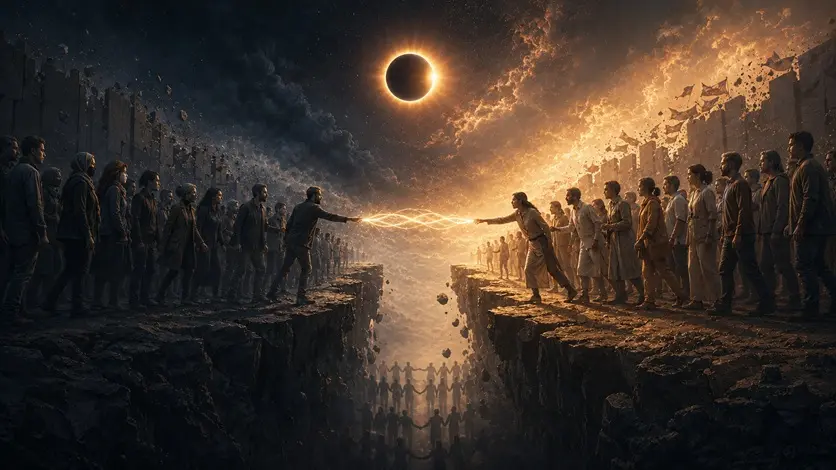
Human beings constantly divide themselves into opposing groups. We separate ourselves by nation, race, religion, politics, wealth, class, and countless other identities. Once the categories are established, it becomes easier to see the people on the other side as enemies.
The title reduces this entire problem to two words: us and them.
The song examines war, but its meaning extends beyond the battlefield. The people sent to fight one another are often not natural enemies. They are ordinary human beings who have been assigned opposing identities by people in positions of power.
The same process happens throughout society. We are told who belongs, who does not, whom we should trust, and whom we should fear. People experiencing poverty or suffering can be ignored because society has placed them in the category of “them.”
Even the music illustrates this conflict. The quiet verses feel gentle and human, but they repeatedly explode into enormous choruses. Harmony is interrupted by division.
This is one of humanity’s oldest problems. We forget that the person across the border, on the opposite side of a political disagreement, or inside a different religious tradition experiences the same fear, hope, love, pain, and mortality that we do.
Beneath all our labels, there is no “them.” There is only us.
“Brain Damage”: Who Is Really Insane?
The “lunatic” in “Brain Damage” has several possible meanings.
The most personal reference is likely Syd Barrett, Pink Floyd’s original leader, whose mental health deteriorated before he left the band. However, the lunatic gradually becomes something larger than one person.
At first, the lunatic appears to be somewhere outside. Then he enters our homes and thoughts. Eventually, the boundary between the supposedly normal person and the lunatic begins to disappear.
This raises an unsettling question: Who is actually insane?
Is it only the person whose mental illness is visible? Or is there something insane about a society that wastes human life, glorifies greed, sends young people to war, suppresses individuality, and teaches us to see our neighbors as enemies?
The album is compassionate toward the person called mad and suspicious of the society calling itself sane.
The lunatic may represent someone who has been crushed by the pressures explored throughout the album. He can also represent the spiritual blindness of society itself.
We become spiritually blind when we stop seeing people as people. We become spiritually blind when money matters more than human well-being. We become spiritually blind when we are so busy that we never stop to experience our own lives. We become spiritually blind when loyalty to a nation, religion, political party, or social group becomes more important than love.
In that sense, the lunatic is not merely somewhere else.
The lunatic is in all of us.
What Is the Dark Side of the Moon?
The “dark side of the moon” is best understood as a metaphor for the hidden side of the human mind and the unexamined side of society.
It represents our fear, greed, hostility, alienation, mortality, and capacity for madness. These things exist within humanity, even when we pretend they belong only to other people.
The dark side is therefore not completely evil, nor is it something we can simply destroy. It is the part of ourselves that we often refuse to examine. When ignored, it can control us. When brought into the light, it can lead to greater honesty, self-awareness, and compassion.
Near the end of the album, a voice explains that there is no dark side of the moon because the moon is actually all dark. It only appears illuminated because the sun shines upon it.
Symbolically, darkness does not belong to a separate category of bad or insane people. It exists within everyone. Part of us is illuminated, while another part remains hidden.
The task is not to pretend that we are completely made of light. It is to become conscious of our darkness so that it does not eclipse the light within us.
“Eclipse”: Everything Is Connected
“Eclipse” brings the entire album together.
The song gathers virtually every part of human experience: everything we touch, see, feel, love, hate, create, destroy, possess, give, and lose. All of it belongs to one interconnected existence.
Then the sun is eclipsed by the moon.
The darkness can temporarily cover the light, but it cannot destroy it. The sun remains present even when we cannot see it.
That is why I do not believe The Dark Side of the Moon is ultimately nihilistic. It is dark, but it is not hopeless. Its moral center is empathy.
The album warns us that time, fear, money, power, and tribalism can eclipse our humanity. It asks us to recognize our shared vulnerability before the pressures of life make us forget that we belong to one another.
Pink Floyd’s official retrospective describes the album as examining greed, mortality, the dark and light sides of the human psyche, and humanity’s place in the cosmos. The album does not give us a formal religious doctrine. It gives us something more open-ended: an invitation to look honestly at ourselves and decide how we want to live.

The Simple Revelation: Choosing Light Over Division
This is where The Dark Side of the Moon connects with the Simple Revelation.
The Simple Revelation begins with the understanding that God is love and benevolence. God loves everyone unconditionally and inexhaustibly. God is in everyone, and everyone is in God.
If God is present in every person, then the division between “us” and “them” is ultimately an illusion. We may have different cultures, beliefs, nations, appearances, and experiences, but we exist within the same divine reality.
There is no group of people who possesses God exclusively. There is no nation, religion, leader, or institution that stands closer to God than the rest of humanity. No mediator is required. The same divine presence exists in every person.
When we dehumanize someone else, we become blind to the presence of God within them. When we exploit others for money, sacrifice human beings for power, or allow our tribal identities to overcome our compassion, the darkness within us eclipses the light.
But the light remains.
Our purpose is not to escape the human experience. It is to live it fully and grow in a positive direction. We are here to love, learn, create, help one another, practice gratitude, and make the world better while we still have time.
“Time” reminds us not to sleep through our lives.
“The Great Gig in the Sky” reminds us that death is part of our journey.
“Money” reminds us not to confuse possessions with purpose.
“Us and Them” reminds us that division destroys our ability to recognize one another.
“Brain Damage” reminds us that both madness and darkness exist within all of us.
“Eclipse” reminds us that everything is connected and that darkness can hide the light without destroying it.
The Simple Revelation ties these truths together in one spiritual message: God is love, God is in everyone, and everyone is in God. Therefore, there is no “us and them.” There is only us.
Our time is short. Money will not save us. Tribalism will not heal us. Fear will not unite us. But love can bring us back to ourselves and to one another.
The light has never left us. It has only been eclipsed.
Our task is simply to let it shine again.